Re-enchanting the Champs-Élysées — Christophe Léribault
- Publish On 19 February 2020
- Christophe Léribault
- 1 minutes
Registration confirmed
You will receive STREAM VOICES, at the following address :
Eager to share more generously the results of its collaborations and research, PCA-STREAM publishes STREAM VOICES, its online magazine!
*Mandatory Field
“ A catastrophe is when a belief or certitude suddenly collapses. From its ruins, narrative, political, economic and ecological utopias can be reborn. ”
Raphaëlle Guidée
“ A catastrophe is when a belief or certitude suddenly collapses. From its ruins, narrative, political, economic and ecological utopias can be reborn. ”
Raphaëlle Guidée is a specialist in narrative representations of economic, environmental and societal collapse. For over 10 years, she has analyzed the narratives surrounding Detroit’s bankruptcy in order to understand how an apparent ruin of capitalism can inspire discourses of domination or resistance. In La ville d’après : Détroit, une enquête narrative [The Aftermath City: Detroit, a narrative investigation] (Flammarion), rather than focusing on fictions, she seeks out testimonies and concrete stories, believing that modern times don’t need new narratives. We simply need alternative narratives. Read the transcription of the podcast.
Philippe Chiambaretta, Nicolas Bourriaud
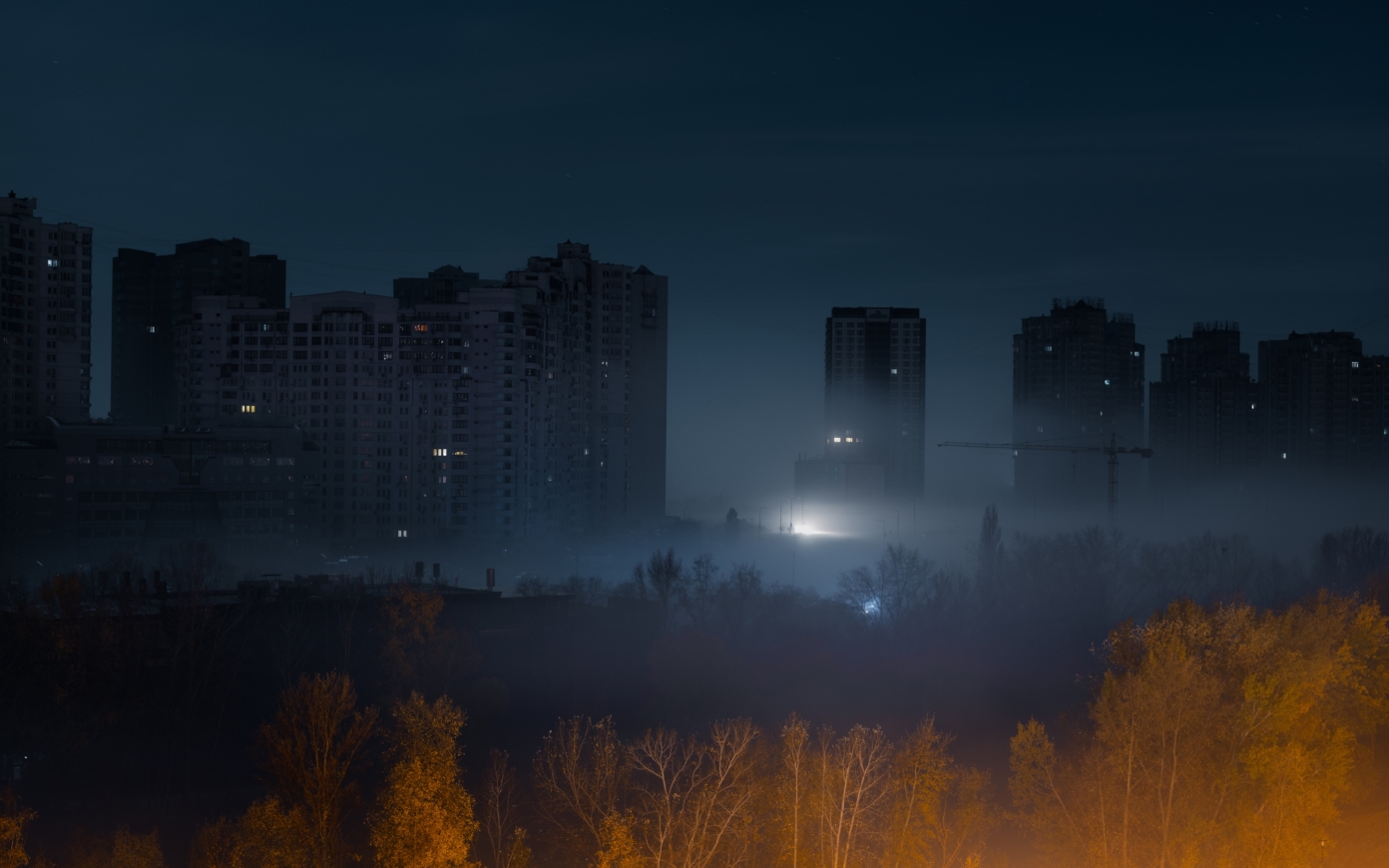
L’agence PCA-STREAM dirigée par l’architecte Philippe Chiambaretta a signé en 2006 le projet de réhabilitation d’un immeuble tertiaire destiné à accueillir le tout nouveau Centre d’Art Contemporain de Kiyv. Le projet architectural s’est construit en parallèle du positionnement éditorial et de la constitution de la collection, en collaboration étroite avec le mécène du projet Viktor Pinchuk et le curateur Nicolas Bourriaud. Retour sur la genèse de ce projet ambitieux, destiné à ouvrir l’Ukraine sur le Monde.
Ashfika Rahman
Ashfika Rahman is a visual artist based in Bangladesh, who recently won the Future Generation Art Prize awarded by the PinchukArtCentre in Ukraine. Faced with the overwhelming power of information systems that are serving dominant narratives, she is working on creating alternative medium of expression, giving their voice back to marginalized communities in her homeland, particularly women. Through her art, Rahman questions myths, folk tales and widely spread prejudice that are still shaping our cultures and legitimating violence, adopting a contemporary and feminist lense. We met with her to discuss her recent work, Behula These Days where she brings together ancient crafts and new techniques to share the poignant and heart-wrenching experiences of women living in one of the most floodprone areas in Bangladesh.
Raphaëlle Guidée
Raphaëlle Guidée is a specialist in narrative representations of economic, environmental and societal collapse. For over 10 years, she has analyzed the narratives surrounding Detroit’s bankruptcy in order to understand how an apparent ruin of capitalism can inspire discourses of domination or resistance. In La ville d’après : Détroit, une enquête narrative [The Aftermath City: Detroit, a narrative investigation] (Flammarion), rather than focusing on fictions, she seeks out testimonies and concrete stories, believing that modern times don’t need new narratives. We simply need alternative narratives. Read the transcription of her podcast below.
“ Architecture has a unique relationship with the transformation of reality: it is, in a way, atlastic. ”
Manuel Bello Marcano
“ Architecture has a unique relationship with the transformation of reality: it is, in a way, atlastic. ”
Manuel Bello Marcano is an architect, lecturer at ENSA Saint-Etienne and sociologist of the imaginary at the Centre d’études pour l’actuel et le quotidien – CEAQ, Université Paris Descartes (Center for Current and Everyday Studies at Paris Descartes University). In his view, architecture is an act of aggregation designed to put the world in order: in this sense, he is interested in the political fictions mobilized to equip our thinking and, in this case, to build a “ togetherness ”. Follow his words and discover animality understood as community.
“ En architecture, le sonore demeure une dimension à la fois floue et insaisissable. Il échappe au dessin et au plan, et pourtant, c’est lui qui fait vibrer l’espace, qui le rend habitable et mémorable. ”
Carlotta Daro co-led, together with Nicolas Tixier, the Radio Utopia project that animated the French Pavilion at the Venice Biennale in 2023. She is now part of the Gramazio Kohler research group, which focuses on the contribution of digital technologies and new materials to architectural design. There, she leads a research project dedicated to developing virtual reality tools enriched with acoustic simulations, designed to support architects throughout their creative process. This work paves the way for a constructive approach in which sound—too often considered primarily as a nuisance—moves beyond measurement and mitigation to become a perceptual and experiential factor.
Jean-Baptiste de Froment
On the occasion of its integration into the Paris Sciences et Lettres (PSL) university consortium, the École nationale supérieure d’architecture de Paris-Malaquais is publishing a manifesto that asserts its institutional positioning. Far more than a mere text, this manifesto lays the foundations for a committed academic vision, emphasizing the urgent need to train architects engaged in transforming the ways we inhabit the world. Structured around twelve key concepts, it is intended as a compass to guide the school’s pedagogical and strategic choices, in alignment with the 2025–2029 National Strategy for Architecture. In this interview, its director, Jean-Baptiste de Froment, reflects on the values driving this project and on how the school positions itself as a proactive agent of thought and action within the contemporary architectural landscape.
Émilie d'Orgeix, Corinne Feïss-Jehel, Pierre-Jérôme Jehel
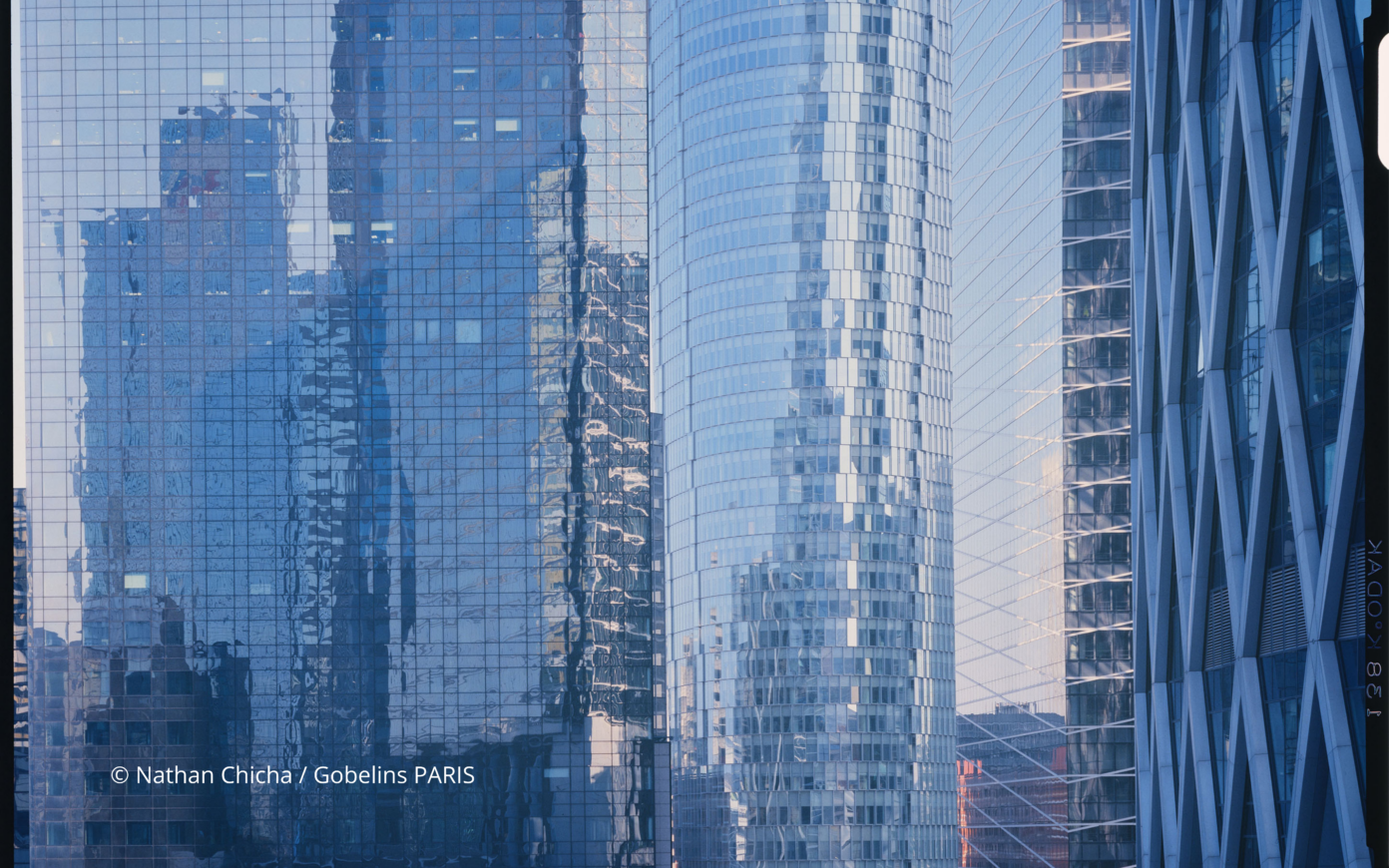
Over the span of several months, students from GOBELINS Paris scouted La Défense, examining the iconic business district from the fresh perspective of urban metabolism. As part of a documentary workshop led by Pierre-Jérôme Jehel and Laetitia Guillemin (GOBELINS) and designed in partnership with researchers from the City-Metabolism Chair at PSL University, some thirty students explored this territory. They did so by treating it not as a mere backdrop but as a living organism, traversed by flows, tensions, and rhythms, using photography as a tool for revelation. Their projects, located at the crossroads of artistic creation and research, unveil an alternative reading of this mineral space, between invisible flows and underlying tensions. Both sensitive and rigorous, this inquiry is chronicled here by Corinne Feïss Jehel (EPHE-PSL), Pierre-Jérôme Jehel, and Émilie d’Orgeix (EPHE-PSL) as part of a research project conducted by the City-Metabolism Chair (which is financially supported by PCA-STREAM, Artelia, and Groupama Immobilier).